There are definitely some perks credit cards offer. They’re convenient, safer to carry than cash, and can earn you some exciting rewards, depending on the provider of your choice. Plus, they offer stronger fraud protection, perhaps even better than debit cards. Since you're technically spending the bank’s money (not yours), it's generally easier to dispute fraudulent charges — unless, of course, you've handed out OTPs to random strangers.
One of the advantages of using credit cards is that, when managed responsibly, they don't usually require you to go into debt. But for first-time credit card owners, having one can sometimes be confusing and, at times, scary. We understand: having one is a huge responsibility. Sam Bugay, a financial advisor from Manulife Philippines, told The Beat Asia that credit cards shouldn’t be treated as “free money.” Instead, first-time owners must treat each swipe as “debt you are obligated to pay back.”
Credit cards are not and will never be a free pass for one to spend irresponsibly. Here, we’ve rounded up some dos and don’ts every first-time credit card owner must know.
Photo from Website/Unionbank
Avoid Paying Only the Minimum Balance
As much as possible, pay your statement balance in full and avoid paying only the minimum balance. Doing so can lead to interest, which becomes harder to pay off as it continues to grow. According to Bugay, paying only the minimum balance is “a dangerous habit.”
“You will end up paying more for your purchases and can quickly fall into long-term debt,” said Bugay. She also mentioned that the primary reason why some credit card users fall into debt is spending beyond their means, emphasizing the importance of only “[purchasing] what you can afford to pay in full.”
Prioritize Paying on Time, Not Chasing a Good Credit Score
Building a good credit history is, of course, a must for every credit card user. However, if you’re a first-time owner, your priority must be paying on time — a good credit score will follow. After all, on-time payments are one of the key factors in getting a good credit score.
Paying your statement balance on time is advisable so you can avoid late fees, which can totally damage your credit score in the future. You can also set up autopay for each month (even at least the minimum payment), so you avoid accumulating additional fees if you forget to pay the full statement balance on time.
Photo from Website/BDO
Review Your Statements Monthly
Upon applying for a credit card, one thing you must consider is that sometimes there can be sneaky charges. This is why it’s important to check your statements from time to time, so you can immediately dispute charges you didn’t personally authorize.
Additionally, reviewing your statements monthly may help you track your spending and potentially cut back on unnecessary expenses, as you’ll gain better knowledge of your spending habits. We know it can be a hassle sometimes, but having control and enough knowledge of your spending can prevent you from making the same credit card mistakes.
Don’t Spend Beyond Your Means
For this one, you need to be realistic. If you know you can’t afford to pay what you owe on time, then that item you’re wishing to purchase is something you can’t truly afford. The credit on your card is not your money — and it never will be. Every purchase you make is a debt that must be paid back. Credit cards are tools for one’s convenience. They are not for someone to use recklessly. It’s technically your utang (debt), and, you know, utangs don’t have a positive ring to them.
“Be brutally honest with yourself. If you are prone to impulse buys or have struggled with spending in the past, a credit card could be [risky],” said Bugay.
Photo from Website/HSBC
Don’t Forget to Unlink Your Credit Card After Canceling a Service
Even the best of us have fallen into this same rabbit hole. It’s not pleasant to be paying a debt for a service you no longer want or weren’t at least able to enjoy. This applies to platforms that require subscriptions, like streaming platforms (Netflix, Disney+, Spotify, and more).
With this in mind, you must always double-check your accounts after canceling a specific service to ensure there won’t be any future charges once your subscription renews. “These automatic charges can be easy to forget,” said Bugay. “If you cancel a service, you must remember to unlink your card.”
Don’t Reach Your Credit Card’s Limit
Just because you can, doesn't mean you have to. Maxing out your credit card limit can not only affect your credit score, but it can also make it difficult to pay off. And if you ever need to apply for loans, banks may see this as a red flag and be less likely to approve your application.
A once helpful credit card can slowly turn into a financial burden once your limit is maxed out. It is, of course, enticing to spend once you see your limit going higher. But practicing delayed gratification and self-discipline can help you stay in control of your finances, and may actually keep you away from further stress.
Get the latest curated content with The Beat Asia's newsletters. Sign up now for a weekly dose of the best stories, events, and deals delivered straight to your inbox. Don't miss out! Click here to subscribe.
Filipino football fans are getting a shot at the world stage, thanks to Visa and GoTyme Bank.
Global digital payment leader Visa teams up with GoTyme Bank for the FIFA World Cup 2026, opening opportunities for fans in the Philippines to experience the tournament live.
With more than 9 million customers locally and over 20 million worldwide, GoTyme Bank has quickly grown into the country’s fastest-growing bank, positioning itself as a platform that connects Filipinos to global opportunities beyond everyday banking.
Through the partnership, Filipino fans can get closer to the action — bringing the global spectacle within reach. As part of its official partnership with Visa for the FIFA World Cup 2026, GoTyme Bank is launching a series of limited-edition GoTyme Bank Visa Debit Cards.
The new, limited-edition cards in Pitch Black and Trophy Gold | Courtesy of Visa, GoTyme Bank
Available in two designs — Pitch Black and Trophy Gold — and featuring the iconic trophy, the debit cards will showcase FIFA World Cup 2026 imagery by Filipino artist Ross Du, adding a distinct local touch to the global tournament. These cards will be available through GoTyme Bank kiosks starting today, March 23, 2026.
Adding to the excitement, fans also have the chance to win an all-expenses-paid trip to the FIFA World Cup 2026 in the United States, courtesy of Visa.
Cardholders of GoTyme Bank debit cards — including the Classic, Pitch Black, and limited Trophy Gold editions — can earn raffle entries with every transaction. A minimum spend of P1,000 earns one entry for the Classic and Pitch Black cards, while overseas transactions of the same amount earn triple entries.
One Classic cardholder and one Pitch Black cardholder will each win an all-expense paid trip for two to attend the FIFA World Cup 2026 Group Stage in Los Angeles, complete with round-trip business class tickets.
Meanwhile, the rare Trophy Gold card — approximately one in 20,000 cards nationwide — offers a more exclusive perk, with no minimum spend required to qualify for entries. One Trophy Gold cardholder will win an all-expense-paid trip for two to attend the FIFA World Cup 2026 Final in New York City, also with round-trip business class tickets.
In addition to the Grand Prizes, customers will also have the chance to receive exclusive FIFA World Cup 2026 Visa Premium merchandise.
(From left) Head of Marketing for Regional Southeast Asia at Visa Gladys Chan, Sam Suguran, and GoTyme Bank President and CEO Nate Clarke | Photo by The Beat Asia
All card types (Classic, Pitch Black, Trophy Gold) are randomly distributed at kiosks nationwide, with the Trophy Gold card being much rarer. Existing cardholders can upgrade to the limited-edition card with a P200 replacement fee, with the new card printed in under five minutes at participating kiosks.
The fly-off promo runs until May 7, 2026, for Classic and Pitch Black cardholders, while the Trophy Gold promo runs until June 10, 2026.
Through its partnership with Visa, GoTyme Bank is bringing Filipino fans closer to the FIFA World Cup 2026 than ever before.
Set to be one of the most widely watched sporting events in history, the 2026 edition will be hosted across three countries for the first time — the United States, Mexico, and Canada. The tournament kicks off on June 11, 2026, with the final scheduled for July 19 in New Jersey.
For more information and updates, visit GoTyme Bank’s website and follow them on Facebook and Instagram.
Get the latest curated content with The Beat Asia's newsletters. Sign up now for a weekly dose of the best stories, events, and deals delivered straight to your inbox. Don't miss out! Click here to subscribe.
Looking for the perfect place to hold your show or creative event in Manila? You’re in luck, as there are plenty of great theaters and performance spaces around the city that fit all kinds of needs. Whether you’re planning a musical, a recital, a workshop, or a big production, you’ll find venues with solid amenities, flexible layouts, and easy access for guests.
In this list, we’re rounding up some of the best performance venues you can rent, plus the features that make each one worth checking out. Let’s find the stage that fits your vision!
Samsung Performing Arts Theater
Photo from Website/Samsung Performing Arts TheaterPhoto from Website/Samsung Performing Arts Theater
Located in Circuit Makati, the Samsung Performing Arts Theater is a premier 1,520‑seat venue designed to international standards, making it ideal for musicals, theater productions, concerts, cultural shows, recitals, conventions, launches, and workshops. Its fully carpeted auditorium spans Orchestra, Loge, and Balcony levels, all easily accessible via elevators, escalators, and stairs.
The theater offers a robust suite of amenities, including 93 dressing‑room spaces, a dedicated green room, conference rooms for production meetings, and a 2,012‑sq. ft. rehearsal hall perfect for warmups or private showcases. Guests can also enjoy four concession areas, a full‑service gift shop, and a spacious lobby with skyline views. The venue also has PWD‑friendly facilities to ensure accessibility for all.
For venue rental or booking inquiries, visit their website to download their theater kit or email inquire.cpat@ayalaland.com.ph.
Photo from Website/PETA Theater CenterPhoto from Website/PETA Theater Center
Located in Quezon City, the Philippine Educational Theater Association (PETA) Theater Center is a dynamic multi‑arts complex designed for performances, workshops, recitals, showcases, and cultural events.
Its main performance space, the PETA‑PHINMA Theater, is a highly flexible black box that can transform into Arena (450 seats), End Stage (420 seats), or Thrust (400 seats) configurations, making it ideal for experimental theater and intimate creative productions. It features comfortable movable seating, multi‑level audience areas, catwalks for technical access, an acoustic ceiling, and movable reflectors to accommodate a wide range of staging needs.
Beyond the theater, PETA has several versatile spaces: the PLDT/SMART Exhibition Hall for receptions or installations, the Lino Brocka Hall for intimate gatherings or workshops, and Studios A and B for bright, sound‑treated rooms perfect for dance, rehearsals, and seminars.
For more details, check the guidelines on their website or contact them directly via phone at +632-725-6244.
Location: PETA Theater Center, No. 5 Eymard Drive, New Manila, Quezon City, Metro Manila 1112
Carlos P. Romulo Auditorium
Photo from Website/RCBC PlazaPhoto from Website/RCBC Plaza
Located in RCBC Plaza, Makati City, the Carlos P. Romulo (CPR) Auditorium is a 450‑seat, state‑of‑the‑art performance venue ideal for Broadway‑style musicals, ballet, opera, recitals, drama productions, and dance showcases. Designed by Fisher Dachs Associates, Skidmore Owings & Merrill, and W.V. Cosculluela & Associates, the theater features professional‑grade acoustics, modern lighting and sound systems, and a comfortable auditorium layout suited for both artistic and corporate events such as conventions, lectures, and presentations.
Within the same building, there are Function Rooms offering multiple meeting spaces — from small rooms for 25 to 30 people to configurable halls that can host up to 200 people — that are perfect for rehearsals, breakout sessions, or pre‑event preparations. Podium Levels 3 and 4 also house dining options and retail services for guests and performers who want to enjoy a meal before or after a show.
For rental inquiries, contact (63) 02 8887‑4941 loc. 111 or email theater@rcbcplaza.com.ph.
Location: CPR Auditorium, 4th Floor, Tower II, RCBC Plaza, 6819 Ayala Ave., Makati City, 1227 Metro Manila
Maybank Performing Arts Theater
Photo from Website/BGC Arts CenterPhoto from Website/BGC Arts Center
Located in Bonifacio Global City (BGC) Arts Center, the Maybank Performing Arts Theater offers a range of flexible, professionally designed spaces ideal for theater productions, musicals, recitals, corporate events, workshops, and private celebrations. Its main venue, the Globe Auditorium, can seat up to 500 guests (theater-style) or accommodate 200 for banquets, featuring retractable seating, modular platforms, an optional orchestra pit, three viewing levels, a catwalk system, and a manual counterweight fly system.
The theater also houses several versatile spaces: the Zobel de Ayala Recital Hall (120 sqm) with sprung floors and mirrored walls for rehearsals, recitals, and shoots; the Dolores L. Tan Hall for workshops, classes, and exhibits; and flexible lobby areas like the NutriAsia Del Monte Lobby and the Daiichi Properties Lounge for receptions, cocktails, and guest flow.
Rental packages include use of lights and sound, technical support, housekeeping, security, and back‑of‑house amenities. For booking inquiries, fill out the form on their website.
Photo from Website/Cultural Center of the Philippines (CCP)Photo from Website/Cultural Center of the Philippines (CCP)
As the country’s premier home for the performing arts, Tanghalang Pambansa in the Cultural Center of the Philippines (CCP) offers a collection of world‑class venues suited for productions of every scale. Its main theater, the Tanghalang Nicanor Abelardo, seats 1,815 guests across four levels and is fully equipped for grand operas, ballets, and large musicals. The space features meticulously engineered acoustics, a split‑floor orchestra lift, and a striking tapestry curtain inspired by National Artist H. R. Ocampo’s "Genesis."
For mid‑sized events, the Tanghalang Aurelio Tolentino (Little Theater) offers 413 seats and a classic proscenium stage ideal for drama, chamber performances, film screenings, and recitals. More flexible options include the Tanghalang Ignacio Gimenez (Black Box Theater) with retractable seating for 272 to 320 guests and multiple stage configurations for contemporary theater, workshops, and immersive productions, and the Tanghalang Huseng Batute that can accommodate up to 240 guests for experimental and intimate performances.
All CCP venues come with professional technical facilities, dressing rooms, lobbies, and support spaces that ensure smooth event flow for performers and organizers. For booking inquiries, contact the Venue Operations Division – CCP Booking Office at bookingoffice@culturalcenter.gov.ph.
Location: Tanghalang Pambansa, Cultural Center of the Philippines (CCP) Complex, Roxas Blvd., Pasay City, 1300 Metro Manila
Proscenium Theater
Photo from Facebook/Proscenium Theater
Located in the heart of Rockwell Center in Makati, the Proscenium Theater offers an intimate front‑row experience where every seat feels close to the action. Its 780‑seat Main Hall combines natural acoustics, acoustic banners, a 16 x 16‑meter stage, a fully automated fly system, and an orchestra pit, making it an excellent choice for musicals, concerts, theatrical productions, and large cultural events.
The venue also houses The Black Box, a versatile 332 sqm performance space with flexible seating for up to 300 guests and a Vivace electroacoustic system, ideal for experimental shows, rehearsals, intimate performances, and creative events that require customization.
Moreover, the theater is a few steps away from the Proscenium Retail Row and Power Plant Mall, offering guests a wide range of dining and pre‑ or post‑show options. For rental inquiries, contact inquire@rockwell.com.ph or fill out the contact form on their official website.
Get the latest curated content with The Beat Asia's newsletters. Sign up now for a weekly dose of the best stories, events, and deals delivered straight to your inbox. Don't miss out! Click here to subscribe.
Dreaming of corseted gowns, whispered gossip, and slow promenades under golden light? While “Bridgerton” may be set in Regency-era England, Manila has its own collection of historic spaces that feel just as romantic and transportive.
From cobblestone streets to grand facades and hidden gardens, these timeless locations let you channel your inner debutante — whether you’re dressing up for a photoshoot, planning a romantic event, or simply craving a moment that feels beautifully out of time for a themed happening.
Here are historical venues in Manila where you can pose and feel like you've stepped into another time or throw a grand party to be the highlight of the social season.
Casa Manila
Photo from Website/Intramuros Administration
Intramuros is, without a doubt, the closest Manila comes to stepping into a full-blown period drama. The famed walled city captures old-world romance with cobbled streets, weathered stone walks, and colonial architecture that transports you to another century. It’s no surprise, then, that three destinations from within its walls have earned a spot on this list.
Wandering through Fort Santiago, Calle Real, or along the ivy-clad walls feels like a slow promenade straight out of “Bridgerton.” From dramatic archways to sunlit gardens and weathered façades, every corner offers a cinematic backdrop perfect for debutante-style portraits or romantic editorial shots.
Our first pick is Casa Manila, where you’ll feel as if you’ve stepped into the private world of a 19th-century Manila socialite. The beautifully restored Spanish colonial house is filled with antique furniture. Capiz-shell windows, grand staircases, and ornate details that offer glimpses of a bygone era.
For visitation, The Casa Manila Museum, as well as the other sites like Fort Santiago and the Baluarte De San Diego, charge a minimal entrance fee of P75 (Adults) and P50 (Students/Seniors).
Intramuros also has various spaces available for rent. The Casa Manila patio is a great outdoor venue for throwing an evening ball or soiree with a capacity for over 120 guests! Rentals start from P24,000 for 6 hours. You can learn more about it here.
Location: Plaza San Luis Complex, General Luna cor. Real Sts., Intramuros, Manila City
Operating Hours: Tuesday to Sunday, from 9 AM to 6 PM
San Agustin Church
Photo by Diego Delso/CC BY-SA 4.0
Timeless and steeped in history, San Agustin Church is located within the walled city and exudes a solemn, cinematic romance that feels straight out of a period drama. In this UNESCO Heritage site, you’ll witness Baroque interiors, vaulted ceilings, and centuries-old stone walls that create an atmosphere that is both grand and deeply intimate.
Beyond the church itself, there’s an adjoining museum and several cloisters that offer quieter and more contemplative spaces like serene courtyards and long corridors lined with curated artifacts and paintings.
While entry to the church is free to visit, the museum has a modest admission fee of P200 (Adults) and P160 (Students, Seniors, and PWDs).
Romance is the core of the “Bridgerton” series, so it’s only right that we include a destination where you can recreate one of the most romantic moments that can happen in one’s life: weddings. San Agustin Church is a favorite when it comes to wedding venues, with several ceremonies taking place over the year. It's definitely an ideal place for classic and traditional wedding ceremonies. Their wedding ceremony package rates may cost upwards of P45,000++.
Location: General Luna Street, Intramuros, Manila City
Operating Hours: Daily, from 8 AM to 6 PM.
Manila Cathedral
Photo from Website/The Manila Cathedral
At the heart of Intramuros lies Plaza Roma, a stately open square framed by some of Manila’s most iconic heritage landmarks. Paired with the grandeur of the Manila Cathedral, the space feels regal and ceremonial, much like the towering mansions and townhouses in the regency series.
The cathedral’s façade, rose window, and symmetrical architecture add an unmistakably aristocratic charm, making it easy to imagine society gatherings and elegant promenades unfolding here. The area is free to access and offers tours, should you want to explore the landmark further. We recommend visiting during the early morning or golden hour for a softer, more romantic glow.
It’s an especially dreamy venue for weddings, vow renewals, or intimate gatherings, where every moment feels ceremonial, romantic, and elegant. For wedding packages, their rates start at P35,000 (without air conditioning) and P45,000 (with air conditioning).
Whether you’re walking down the aisle or posing for photos outside its iconic walls, Manila Cathedral definitely delivers that “royal court” energy.
Location: Cabildo corner Beaterio Sts., Intramuros, Manila City
Operating Hours: Open daily. You can check their website for worship service schedules.
National Museum of the Philippines
Photo from Website/The National Museum of the Philippines
With its towering neoclassical columns and grand staircases, the National Museum of Fine Arts brings a distinct European elegance to the heart of Manila.
It was previously a legislative building, but now the structure stands as a palace-like backdrop that feels effortlessly regal and cinematic. The exterior alone is enough to evoke Bridgerton-level drama, while the interior offers equally striking architecture and paintings for more refined compositions. One highlight is the Spolarium by Juan Luna, one of the largest paintings in the Philippines, which towers inside a spacious hall. The museum is open daily and is free to enter, making it one of the most accessible locations for those seeking a stately, high-society aesthetic.
This destination also makes an ideal venue for events that call for a sense of grandeur and old-world elegance, like a sophisticated gala, an art exhibit opening, or a luxury brand launch. The dramatic exterior alone feels like the entrance to a royal court, while the museum’s interior spaces provide a refined, cultured atmosphere that elevates any gathering.
Location: Padre Burgos Avenue, Rizal Park, Manila City
Operating Hours: Daily, from 9 AM to 6 PM.
Paco Park
Photo from Website/National Parks Development Committee
If you’re looking for greenery to roam, the way high society would promenade the lakeside parks and cobbled avenues, Paco Park offers a quiet and romantic secret garden hidden within the city.
Once a colonial-era cemetery, it has been transformed into a peaceful public park enclosed by stone walls and lined with arched niches. The lush greenery, winding pathways, and soft natural light create an almost poetic atmosphere ideal for introspective portraits or gentle, story-driven photos. It is also the perfect setting for intimate events that thrive on atmosphere, such as acoustic concerts, candlelit recitals, or a small garden soiree with close friends. The park's peaceful pathways create a dreamy, storybook vibe that makes every moment feel poetic and cinematic.
The garden can fit up to 300 guests and is available for rent with rates starting at P16,000 for four hours, excluding ingress or egress rates. For more details, you can view their website here.
If you're up for a visit, the park is completely free to enjoy and is a great spot if you want a break from the hustle and bustle of the city.
Operating Hours: Tuesday to Sunday, from 8 AM to 5 PM
Rizal Park Gardens
Photo from National Parks Development Committee/Website
Rizal Park might be known as a beloved national landmark, tucked inside are garden areas that feel surprisingly charming and a little old-world.
The Orchidarium has leafy walkways and manicured greenery that make it feel like a quiet garden escape, while the Japanese Garden offers peaceful corners with bridges and stone details that are perfect for soft, candid photos.
In “Bridgerton,” we often see elegant outdoor gatherings and garden parties where the social season unfolds under the sun. Rizal Park’s manicured lawns and tree-lined paths make it a perfect setting for that same kind of romantic, open-air event. Whether it’s a small picnic with friends, a chic afternoon tea, or a styled garden party, these spaces give off a timeless and graceful energy that feels like you’ve stepped into a Regency-era promenade... just with a Filipino twist!
Best of all, entry to the park is free, so it’s an easy and dreamy spot for your Bridgerton-inspired day out. For venue rental, rates may vary depending on the location. The Japanese Garden, which can fit up to 100 guests, can be rented for P16,000 to P18,000 for four hours (excluding ingress and egress rates), while the rental rates for the Chinese Garden (which fits up to 150 guests) range from P50,000 to P60,000 for four hours. For other venues under the National Parks Development Committee, check out their website here.
Maynila Ballrom | Photo from Facebook/The Manila Hotel
Few places in Manila feel as timeless as The Manila Hotel. Opened in 1912, it has long been a symbol of old-world elegance, hosting everyone from royalty to world leaders. With its grand hallways, polished wood details, and classic interiors, the hotel feels like a graceful step back in time, perfect for anyone drawn to Manila’s more romantic, historic side.
The hotel has several function rooms and grand ballrooms perfect for your next Bridgerton-inspired event. Fitting up to 300 guests, the Maynila Ballroom makes it easy to feel like the diamond of the season. Designed by National Artist Leandro Locsin, the ballroom’s soaring narra arches, hand-painted ceiling, and iconic Capiz shell chandelier create a truly regal atmosphere. Add in the Tiffany-style windows, soft lighting, and indoor fountains, and it feels tailor-made for "Bridgerton"-style debutante balls, elegant galas, or a night of formal dancing where everything feels cinematic and unforgettable.
For inquiries about their packages or to request a proposal, you can email banquetsales@themanilahotel.com or contact the banquet sales team at +63 285270011 ext 1271 to 1277, +63 28527 8802, or +63 253015500.
I.P. Santos Lawn | Photo from Website/The Henry Hotel Manila
Set inside a beautifully restored heritage house, the Henry Hotel Manila blends classic architecture with a relaxed, lived-in charm that makes it feel both historic and intimate.
With its wide verandas, antique details, and garden courtyard, it’s the kind of place that invites slow mornings, thoughtful conversations, and a sense of nostalgia that feels romantic.
While more understated than a grand ballroom, the Henry Hotel Manila is perfect for Bridgerton-inspired gatherings that feel personal and refined. The I.P. Santos Lawn is a leafy courtyard that lends beautifully to intimate garden parties, afternoon teas, elegant cocktail evenings, and even wedding receptions. Picture soft dresses, string lights, and quiet laughter under the trees. It’s less royal court, more society darling, hosting her closest circle.
For inquiries on reservations and bookings, email reservations.manila@thehenryhotel.com or call +63 9778019568.
The Conservatory | Photo from Website/The Peninsula Manila
The Peninsula Manila offers quiet luxury and old-world glamour. Its grand lobby, surrounded by marble floors, soaring columns, and soft natural light, is a space designed for elegant dining and slow afternoons. With live music often filling the air, it’s easy to imagine lingering here like an aristocrat, observing society and sipping tea.
If you’re looking for a more intimate yet equally elegant gathering, The Conservatory is a standout choice. Lined with tall, arched windows framed in classic panes, the 4,181 sq.ft. space can fit up to 120 guests and is flooded with natural light that shifts beautifully throughout the day, giving the room an airy, almost ballroom-like glow. Soft curtains, high ceilings, and views framed like portraits make it feel as though you’re dining inside a grand European conservatory. Whether it’s an afternoon tea, an elegant luncheon, or a refined soirée, The Conservatory makes every guest feel like part of the season’s most exclusive affair.
To explore more, you may contact their event planner here.
Location: Corner of Ayala and Makati Avenues, Makati City
Las Casas Filipinas de Acuzar
Photo from Website/Las Casas Filipinas de Acuzar
As a bonus to this Manila list, we’re including another destination that’s surely a heritage escape worth the drive. Las Casas Filipinas de Acuzar is just a few hours away in Bagac, Bataan, perfect for anyone who wants history and romance at its finest!
Set on sprawling grounds lined with restored colonial houses and cobblestone streets, it feels like stepping into a beautifully preserved old town where every corner is photo-worthy and steeped in Filipino history.
Aside from being a stunning place to explore and take “Bridgerton”-style portraits, Las Casas has a variety of charming venues you can rent for weddings, birthdays, elegant parties, or outdoor luncheons. Some of the highlighted spaces include the Hotel de Oriente, which can accommodate up to 800 guests within its spacious hall filled with ornately designed ceilings and grand staircases made by local artisans. There’s also the upper ground floor of Casa Sta. Rita, a structure that used to be the biggest house in Sta. Rita, Pampanga, during its time. The best part is that it comes with a beautiful view of the Umagol river and Las Casas’ church, making it the perfect venue for business meetings, luncheons, and intimate gatherings.
To inquire about wedding venues, you can email them at weddings@lascasasfilipinas.com or contact +63 9178729368. For photoshoots, contact reservations@lascasasfilipinas.com or +63 9178729368.
Get the latest curated content with The Beat Asia's newsletters. Sign up now for a weekly dose of the best stories, events, and deals delivered straight to your inbox. Don't miss out! Click here to subscribe.
It all began with a shared passion for photography. In the middle of the pandemic — at a time when nothing felt certain — Mercella “Merphi” Panaguitonand her sister, Thea Panaguiton, took a bold leap of faith. Driven by a desire to give Filipinos access to high-quality, professional portraits they could take themselves, they launched ATOMM Studios, the Philippines’ first self-photo studio.
Today, Merphi serves as the brand’s Co-Founder and Creative Director, shaping an experience that goes beyond simply taking pictures. In her interview with The Beat Manila, she shared the inspiration behind ATOMM’s creation, the challenges they faced in starting something new, and what clients can expect when they book a session — from the creative freedom to the intimate, empowering atmosphere. Merphi also opened up about her journey as a creative entrepreneur and offers thoughtful advice for those hoping to build something of their own in the industry.
Building a Business From What You Love
A photo studio may not have been part of Merphi’s original plan, but her relationship with photography stretches all the way back to her college years. A lifestyle photographer at heart, she took on gigs whenever she could, even launching a small passion project called “The Kind Universe,” where she turned her photographs into charming merchandise like tote bags and notebooks.
Though her creative roots run deep, Merphi pursued a marketing degree at the University of Asia and the Pacific and later built a corporate career at ABS-CBN, spending five years as a digital marketing strategist. After her stint in the media giant, she took an unexpected leap — moving to Spain to teach English to grade-schoolers — a pursuit inspired by her love for travel and the desire to explore a completely different side of herself.
The entrepreneur shared how she was residing there during the pandemic and was stuck there until she was able to come home in 2021.
“I realized it wasn't for me. So I went home. I went home without any vision of going back to corporate. I really didn't have any plans. In between those years, I had the baby business called ‘The Kind Universe’ where I sell my photos through tote bags and notebooks, showing that life can be easy and kind even though it’s hard or uncertain.”
Merphi Panaguiton | Courtesy of ATOMM Studios
It was her sister who first floated the idea of a self-photo studio, a concept already booming in South Korea. At the time, nothing like it existed in the Philippines. With the pandemic creating a demand for low-contact services and the opportunity to be first in the market, the idea simply made sense. Combining Merphi’s strengths in photography and marketing with her sister’s business expertise, the two teamed up to bring ATOMM Studios to life.
“She was like, ‘Let's do something we like to do.’ So we had to backtrack on what I like to do, and that was photography. At that time, I had been bummed for the past four months. When I arrived in the Philippines, I didn't do anything. And they were actually getting concerned. I've been hustling for the past seven years — so hard to the point that I burned out.”
Merphi also shared a funny story of how they had originally planned to name it “Toma,” a Spanish term that meant “to take.” However, when she had looked up the word from a Filipino context, she was surprised to discover that it meant “to drink alcohol.” Not wanting her business the be referenced as such, Merphi and Thea decided to brainstorm a new name. They came up with “ATOMM” by rearranging the letters.
Apart from this passion project, the two sisters are also handling food franchises, but Merphi noted that running ATOMM was a completely different experience, considering it was something new and there wasn’t a blueprint to run the business with.
“We were just courageous enough to start something new. Something that we can explore and really put our own touch into.”
The creative director also pointed out that she felt it was a market need at that time, stating, “We needed a convenient photo studio. Everybody would want to have nice photos at some point in their life, and it's hard to get that unless you have a nice camera. So I wanted to address that — that sweet spot wherein we need to give Filipinos a chance to have nice portraits. Not just solos, but also group photos with family or barkadas (friend groups).”
When asked about the challenges of starting the business, Merphi shared that launching ATOMM in the middle of a pandemic was no easy feat. With no existing blueprint or business model to follow, they had to build everything from the ground up — improvising, experimenting, and constantly reassessing how the studio should operate.
Despite their limited resources, the sisters made the most of what they had by leaning heavily into social media. Merphi’s digital marketing background proved invaluable, and shortly after they created their online pages, ATOMM began to gain traction. People started sharing their posts, bookings quickly filled up, and influencers soon followed. What began as a simple idea steadily grew into a full-blown trend.
Looking back, Merphi expressed her excitement at the studio’s trajectory — how a passion project transformed into a thriving business. For her, ATOMM stands as proof that entrepreneurship doesn’t have to be driven purely by profit. It can also be fueled by joy, creativity, and the desire to build something meaningful.
“I said maybe this is a perfect platform where we can practice trusting in the divine timing,” she told The Beat Manila, saying that entrepreneurship is equal parts planning and timing.
Courtesy of ATOMM StudiosCourtesy of ATOMM Studios
ATOMM Studios offers more than just a chance to take professional photos, but encourages its clients to celebrate the big and little joys of life. The co-founder noted how they advocate for authenticity. This is translated through their photos, which are edited but not photoshopped, and only touch up on the color.
When asked how ATOMM balances guiding customers and giving them the freedom to take photos their own way, Merphi explained that it all boils down to the experience they offer.
“We wanted people to feel like they are welcomed. That they feel safe in that space and feel taken care of.Basically, the moment they book in our studio, we make sure to take care of our clients until they get their photos, guiding them and explaining to them what to do.”
The studio embraces a minimalist aesthetic: cream walls, clean lines, light wood accents, and warm lighting that create an inviting, comfortable atmosphere. Merphi described ATOMM Studios as a hybrid photo studio,blending traditional and modern processes. While it functions as a self-shoot studio, staff members are always on hand to guide clients through each session. At the same time, a curated photo wall offers pose inspiration for those who want it. Clients are encouraged to relax, have fun, and express themselves freely. “The choice is yours,” Merphi emphasized.
Sessions are based on the number of participants and the chosen duration. Each person costs P400, while photoshoot durations range from five minutes (P200) to one hour (P1,400). This means a solo shoot can go for as low as P600 for a five-minute session.
For fur parents, ATOMM Studios is proudly pet-friendly, allowing you to include your furry companions in your photos. Pets are charged at P500 per pax, but your first pet joins for free!
Courtesy of ATOMM StudiosCourtesy of ATOMM Studios
ATOMM Studios also operates on a booking basis, but would sometimes take in walk-ins if schedules aren’t full. However, it’s highly encouraged to book a slot to ensure that the team will be able to provide you with the best service possible.
“We really want to keep the energy and the sacredness of the experience. We want to practice respect for the business and for the clients who have already booked in advance. To get to the studio, it has to be intentional. This is a space where you’ll make moments you’ll remember forever. The space is a reflection of us and a reflection of our clients. So that’s how we want to keep it going.”
She also shared that something she’s really proud of is the photos her clients receive, as they’re not your typical print and go. But again, it’s the experience that sets them apart.
“It’s the ATOMM feel,” she said. “It’s what keeps people coming back. It’s even become a tradition for some of our clients, and I think that’s our advantage, being ahead in the game. We wanted people to feel special. They can celebrate their most authentic selves by taking photos in our studio. That’s where we really position ourselves.”
Courtesy of ATOMM Studios
As for what’s next for ATOMM Studios, Merphi shared that they’ve already begun expanding their services, such as the photobooth, which can be rented out for events. They’re also looking into more cities to establish new branches in the metro.
“Our vision is really to give Filipinos an opportunity to have nice photos. We want to cater to as many Filipinos as we can.”
Additionally, they’re also exploring a new type of service called a roving photographer, which is a hired photographer for events. Merphi expressed her excitement over this new offering, saying how she’d be able to return to her photography roots.
Beyond plans to expand, Merphi stated that their main goal is to continue providing the best service for their clients. When asked if she had any advice for creatives who wish to create something meaningful, she replied, “Find something you love to do, and at the same time, find something that will give you stability. In the span of four years in the creative industry, I learned that there’s a balance that you have to play with, which is how you survive and how you enjoy while surviving. I don't want to just survive — I want to practice living life, because we deserve it. Filipinos deserve a good life. Also, it starts with you. When you start with yourself, the rest will follow. So my advice is you have to keep yourself as authentic as possible.”
Loading...
Sessions can be booked here. For inquiries on their other services, you can contact them via email at hello@atommstudios.com.
Address: Unit 201-A, Lot 6 Blk 7 Batasan-San Mateo, Quezon City
Operating Hours: Saturday and Sunday, 1 PM to 8 PM
ATOMM Studios Makati (Pop-Up)
Address: Mezzanine 1, LPL Center, Leviste Street, Makati City
Operating Hours: Saturday and Sunday, 1 PM to 8 PM
Get the latest curated content with The Beat Asia's newsletters. Sign up now for a weekly dose of the best stories, events, and deals delivered straight to your inbox. Don't miss out! Click here to subscribe.
The European Higher Education Fair (EHEF) 2025 returns this November, bringing fresh new opportunities for Filipino students wishing to explore European higher education.
Organized by the Delegation of the European Union to the Philippines, together with the Embassies of the EU Member States, this year’s fair welcomes Latvia, Romania, and Slovakia as first-time participants, expanding the network of European institutions available to Filipino learners. In total, 97 institutions, embassies, and cultural institutes from across the EU will be joining this year’s edition.
Photo from Instagram/EHEF Philippines
Set to take place on Nov. 21 and 22, 2025, at the Midtown Atrium of Robinsons Manila, with a series of online sessions available on the 24th if they are unable to attend the onsite event. The fair will be introducing new program highlights, including the Copernicus Program, the EU’s flagship Earth Observation program, and EURAXESS, the EU platform supporting researcher mobility and career development.
A special session on Erasmus+ Capacity Building for Higher Education (CBHE) will also spotlight the EU’s continued commitment to fostering innovation, collaboration, and network building within the Philippine higher education sector.
“Each year, EHEF grows not just in size but also in depth,” said His Excellency Massimo Santoro, European Union Ambassador. “With new EUMS states joining us and new program sessions expanding our offerings, we are opening more pathways for Filipino students and researchers to connect, learn, and thrive in the EU. This reflects the EU’s continuous dedication to making education a bridge between nations and cultures.”
Courtesy of EHEF Philippines
Beyond showcasing degree programs and scholarships, EHEF 2025 emphasizes education as a bridge between nations — an avenue for cultural exchange, language learning, and personal growth in a globally connected academic world.
The European Higher Education Fair (EHEF) 2025 is supported by the Commission on Higher Education (CHED), together with regional hubs including University of Santo Tomas (Metro Manila), University of the Cordilleras (Luzon), Eastern Visayas State University (Visayas), and Xavier University – Ateneo de Cagayan (Mindanao).
University partners include Ateneo de Davao University, Caraga State University, De La Salle University, Far Eastern University, Holy Cross of Davao College, Lyceum of the Philippines-Manila Campus, Mindanao State University – Iligan Institute of Technology, Pampanga State Agricultural University, Polytechnic University of the Philippines, University of San Agustin, University of the Philippines Manila, and Visayas State University.
Get the latest curated content with The Beat Asia's newsletters. Sign up now for a weekly dose of the best stories, events, and deals delivered straight to your inbox. Don't miss out! Click here to subscribe.
It’s not rare to see when tradition meets technology today. And in a move that’s bold and brilliant, the University of the Philippines Manila (UP Manila) is stepping onto the global stage in collaboration with OpenLearning, an Australian education technology platform, armed with AI-powered online courses that promise to deliver Filipino academic excellence to learners around the world.
The collaboration will launch 21 online courses this December 2025, spanning disciplines from health sciences and public policy to Filipino culture and leadership. These courses are designed to be self-paced, modular, and accessible worldwide, making them ideal for students, professionals, and those eager to learn.
Photo from Website/UP Manila
What sets this initiative apart isn’t just the content but also the delivery. OpenLearning’s platform uses artificial intelligence to personalize the learning experience, adapting to each user’s pace, preferences, and progress. That means no typical lectures or passive scrolling. Instead, learners engage in dynamic, community-driven modules that reflect UP Manila’s signature “Tatak UP” ethos: excellence, integrity, and service.
UP Manila Chancellor Michael Tee and OpenLearning CEO Adam Brimo have both emphasized the cultural significance of the project. For Tee, it’s about showcasing Filipino values on a global canvas. For Brimo, it’s a chance to expand OpenLearning’s AI-powered footprint in Southeast Asia.
“UP Manila’s partnership with OpenLearning is aligned with our commitment to continuously develop the country’s health human resources, thereby contributing to the achievement of universal health care goals,” Tee said.
Enrollment opens this month, initially for UP students and alumni, with public access to follow shortly thereafter. Whether you're in Hong Kong or Bangkok, Manila’s academic heartbeat will be just a click away.
Get the latest curated content with The Beat Asia's newsletters. Sign up now for a weekly dose of the best stories, events, and deals delivered straight to your inbox. Don't miss out! Click here to subscribe.
At just 21 years old, Gian Dizon has already carved out a name for himself as the founder of Playahz, a culture-first creative agency rooted in community, authenticity, and lived experience. From flea markets and pop-up gigs to TEDx stages and national brand activations, the college student has proven that creativity doesn’t need a Silicon Valley playbook to thrive; it just needs connection.
In our latest Elevator Pitch, we sat down with Gian and talked about the origins of Playahz and its unique service model, the challenges of running a company at such a young age, and his vision for taking the agency further while keeping its heart anchored in the communities it serves. We delved into the mindset of a creative entrepreneur and the grit necessary to build something real and lasting from the ground up.
Building a Brand from Experience
Gian’s journey as an entrepreneur began earlier than most. At just 12 years old, back when fidget spinners, pocket tees, and tropical polos were at their peak, he spotted an opportunity among his friends and classmates. Recognizing the craze, he made his first business move: sourcing these in-demand items from Manila and bringing them back to Calamba, Laguna, where he was based at the time. What started as a small hustle quickly became his first lesson in supply and demand, teaching him the value of timing, resourcefulness, and listening closely to what people wanted.
“I actually started contacting manufacturers in terms of the pocket tees,” he shared with The Beat Manila. “They were shocked to find an 8th grader reselling their own pocket tee, so they made me a dealer. I didn’t have to purchase up front, so it was more of a pre-order basis.”
“I’m also a big fan of social media. I was scrolling through my feed all day, and eventually I got to learn more about how brands do it, how they build a community. I started joining communities like Social Media Marketing Philippines. It was also the time when vloggers were a thing, and I was interested in doing that type of content. ‘Facebook GG’ [Facebook Gaming] was also a thing back then, so I started streaming and really just exploring and enjoying what I want.”
Around 2020, Gian landed his first “friend-client” when he collaborated with streetwear brand REVEL, founded by Mykee Jofet Rojas and Chelseah Hilary Ongsee — a well-known influencer and sibling to social media personalities Natalia Ongsee, Ranz Kyle, and Niana Guerrero. That early opportunity opened doors, allowing Gian to expand his network.
By the time he returned to his hometown in Batangas, brands had already begun reaching out to him. His first official project came through Al James merchandise, a connection he built via DougBrock TV (DBTV), which had a production company that specialized in music called TMP. After parting ways with the company, Gian shifted his focus to freelancing, steadily building a portfolio by creating content for brands, producing shoots, partnering with venues, and later branching out into event organization. Since then, he has worked on major projects, including 10X in Manila held at Solaire Resort, and most recently, an event under Philippine Blockchain Week at the SMX Convention Center in June 2025.
Gian is also balancing school with his work and is currently a third-year college student studying Marketing Management at De La Salle Lipa. He had also earned his Accredited Marketing Professional (AMP) license, which certifies him as a marketer.
Courtesy of Playahz Creative Agency
Each step in this journey has marked Gian’s growth, not just as a creative but as a young entrepreneur shaping spaces for culture and community. This is the cornerstone of how Playahz began, a culture-first creative agency that operates on both a community and commercial level, bridging the people who move culture and the brands trying to keep up with them. The company was officially established in late 2023, starting as a media publication meant to inform people about what was happening in the music scene.
“I've really been learning a lot, and I've done most of the execution myself. Initially, I had an on-call team, but since they're on-call, there’s no commitment. So it’s just me, full-on committed to this, but having partners who are on and off,” he explained. “But at some point, I saw that my interest lies in the production field. I really wanted to push with Playahz, so I decided, okay, how can I make it a unique asset zone? I studied the whole business side of it, and unlike other production companies that are exclusively towards B2B, we also cater to B2C, and we treat it like a rat experiment. We call it ‘Playground events,’ where we learn about how people react to certain things and different types of activations. Just basically getting their feedback and connecting with communities. That has become the forefront of Playahz — not just to engage the scene but to connect brands and communities.”
According to their company profile, Gian built Playahz to help brands “break through the noise not with more ads, but with deeper presence, intentionality, and human insight.” With Playahz, he was able to create an agency that helps brands become part of the community, not just target it.
When asked why it was important for the company to be culture-first, he replied, “When you do things, you always consider the audience. I've experienced some moments where I've worked with different brands and people, and at some point, they get lost in what could be or what’s in honor of the event — where did the idea derive from? Being creative is really good, but there are just some points where we just have to respect the culture that's already built within that exercise or activity,” he explained.
Courtesy of Playahz Creative Agency
“They forget where it stems from and the values that should be upheld and delivered during the execution. And what we do differently is we don't just go to events to just read the room and how they do it, but we try our best to actually learn from the people, and adapt on the spot. So when we cater this activity or pitch this type of activity to brands, we know what we should be doing, and we know what people would actually enjoy.”
Gian may not have had formal agency training, but it seemed that being street-learned has given his company a unique edge. For B2B, Playahz brings behavioral insight into strategy and production with a service menu that will soon include Content Production, Creative Direction, Promotion, Logistics, and Talent Sourcing.
Although based in Lipa, the agency also operates in Manila. When asked if there are any benefits or disadvantages to setting up shop outside of the capital, Gian answered, “I believe it's good to have this outside perspective. I’m from Batangas, and I’ve always been surrounded by people who want to experience this or that event, and I always ask the question ‘Why? Why do you want to experience this?' That’s one of the things that really builds my idea of how I should structure an event. Since I’m also still a student, I have a good grasp of the student market, so when I go to Manila for the events, I know how to target them.”
“Disadvantage-wise, logistics is always a problem. Most of my clients are from Manila. During our early phases, we really didn’t have people who could represent us there, but now we do. I partnered with various people who could meet up with these clients, who could deliver this type of output when I’m not around during the early phase.”
Courtesy of Playahz Creative AgencyCourtesy of Playahz Creative Agency
As a young founder, Gian has been steadily growing as a leader, learning from every experience while managing a diverse team of both full-time and part-time members. When asked about the systems and structures he has developed to help the agency stand on its own and operate efficiently, he shared that Playahz is guided by values rooted in a family-like culture.
“One of my very important learnings is that when someone is drowning, you don't throw a comment, you offer a hand,” he said. “You only comment once a project is done. We’ve had our fair share of experiences of just trying to deliver projects, and one of my learnings out of that is your team will be there, but you have to set that standard to always aim to complete, not just deliver. So I always ensure that when I onboard people to the projects, they have no prior commitments at that time.”
Gian further explained that although it is commendable to want to try or balance several things, he wants his people to understand that they must be fully available and committed to a project. He also mentioned that having worked with people whom he considers friends has helped him build the business on trust.
“I know there's been this talk on social media that we shouldn’t work with friends, but we’ve had this understanding that whatever happens, this is work life. This is not our personal life. This is just another version of us striving to learn and earn.”
From our conversation, it’s clear that the young founder considers Playahz as a learning experience, something he intends to build and expand in the years to come. From music video launches in Makati City to organizing fashion shows and pop-up booths for Batangas-based brand Nifties, Gian is gaining more knowledge with every project, leveling up their game as they work with various clients. The founder also shared some of his goals for the company, which included establishing a more permanent team, as well as establishing the name “Playahz” in the market as a competitive creative agency.
“There's this stigma that when you go to Manila, it’s more competitive. That's the mindset of every senior high school student who wants to go to a university-belt college. But competitiveness relies on the choices you make and the privilege you have. So we just want to build that idea that you don't find competition in places, you set yourself to be how competitive you want to be,” he stated. Gian also shared that they aim to be the Filipino version of “Emily in Paris,” and to expand not just locally but also internationally eventually. They also have several events lined up throughout the year, forging partnerships with music labels, local retail brands, and speakeasy bars across Manila and Lipa.
When asked about the best advice he’s gotten through his entrepreneurial journey, he replied that it was to work on things you want and enjoy, to make mistakes, learn from them, move forward, and then do it all over again." As for the advice he would give other young entrepreneurs hoping to build something meaningful, he answered, “I encourage people to hear people out, but at the same time know the people you're hearing it from and decide whether to take it or not. Advice is really important, but make sure that the one giving you that advice is really someone you find credible.”
Enjoyed this article? Check out our previous Elevator Pitch profiles here.
Get the latest curated content with The Beat Asia's newsletters. Sign up now for a weekly dose of the best stories, events, and deals delivered straight to your inbox. Don't miss out! Click here to subscribe.
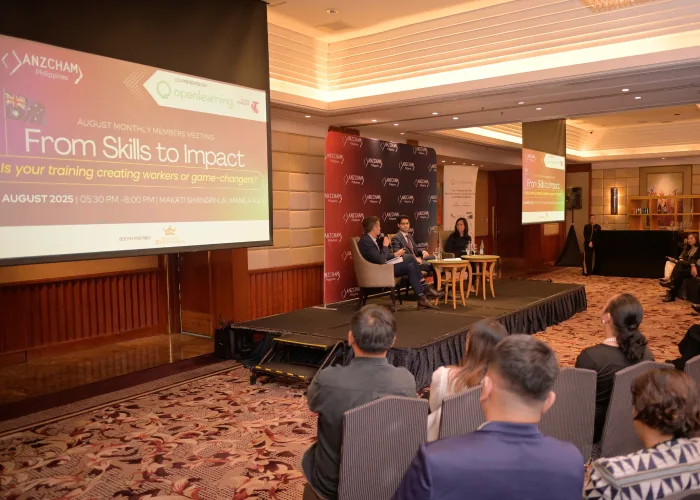
Workplace training is often viewed as too boring, too repetitive, and too time-consuming. Sometimes, they’re even the first thing to be rescheduled and the last one to be viewed. But last Aug. 12, 2025, the Australian-New Zealand Chamber of Commerce (ANZCHAM) proved that learning at work doesn’t have to feel like a chore.
At the August Monthly Members’ Meeting, held at the Shangri-La Makati, industry leaders and companies came together for an in-depth session on how workplace training and education can empower both people and organizations. The event was co-presented by OpenLearning, a next-generation LMS redefining how education is delivered and experienced, alongside Rancho Bernardo Luxury Villas and Resort.
Courtesy of Australian-New Zealand Chamber of Commerce (ANZCHAM) Philippines
The session, moderated by ANZCHAM Director and GHD General Manager – Philippines Simon Terry, the meeting highlighted a stimulating discussion on the importance of curating training that directly contributes to an organization’s employee value proposition, with OpenLearning’s Founder and CEO Adam Brimo and Telstra Foundation Philippines’ Founding Operations Head Nannie Macalincag.
ANZCHAM's Simon Terry, OpenLearning CEO Adam Brimo, and Telstra Foundation Philippines' Nannie Macalincag | Courtesy of Australian-New Zealand Chamber of Commerce (ANZCHAM) Philippines
Rethinking Corporate Training Strategies
The conversation opened with two big questions: “Which area is the most important to focus on in upskilling the workforce?” And, “What’s the biggest challenge in delivering education in your organization?”
The answer pointed to a shift already in motion. Companies are moving away from the “tick box” compliance programs and towards more tailored, on-demand learning that is relevant to employees. Organizations can use tools like OpenLearning’s AI Course Builder to create training sessions that are specific to the company’s requirements and demands.
“Our AI Course Builder is a step-by-step design tool that an HR Department could use, and you can generate structured project-based to competency-based learning aligned to the requirements of the task for the skill you want people to develop,” explained OpenLearning CEO and Founder Adam Brimo.
OpenLearning CEO and Founder, Adam Brimo | Courtesy of Australian-New Zealand Chamber of Commerce (ANZCHAM) Philippines
Hybrid and remote work setups also play an important role in rethinking corporate training strategies. Training now must be engaging enough to cut through screen fatigue, while still fostering collaboration and community online. “Creating those kinds of learning experiences where you can have that level of interaction and engagement is very important,” Adam added. “It not only helps achieve the outcome but also builds a sense of community and camaraderie within the organization.”
Another trend noted is the shift towards “on-demand” and “just-in-time” training courses over structured, “once a month” sessions. Telstra Foundation Philippines’ Nannie Macalincag echoed the sentiment: “You can learn something online on your own, at your own pace, and face-to-face interactions can be reinforced. That way, the conversation continues, and the learning sticks.”
This shift reflects a bigger truth we must get accustomed to: workplace training works best when it is relevant and empowering.
The Role of AI in Workplace Training
Despite its rapid rise across industries, there is still some hesitation with using AI in education, mainly because there is no clear way of seeing where it’s taking us. But at OpenLearning, their goal is clear: to make education a more social and constructive experience.
“When we look at how AI can be used, we focus on connection,” Adam said. “AI can increase the connection between two people who wouldn’t ordinarily meet and generate activities in the training environment that people would prefer.”
Investing in the Next Generation of Employees
The session also highlighted how companies and organizations are now restructuring their training and education to nurture their future talent. Nannie Macalincag shared that companies taking the personal approach to learning are doing it right.
“Offering a greater flexibility that’s aligned to whatever it is the employees or team members need at the moment makes the difference,” she said. “Some organizations miss the mark when they treat training and learning as a token benefit. If employees can’t apply the skills they’ve learned, the value of that benefit is quickly lost.”
Telstra Foundation Philippines' Founding Operations Head, Nannie Macalincag | Courtesy of Australian-New Zealand Chamber of Commerce (ANZCHAM) Philippines
To shift this mindset, Nannie said that learning should be integrated into daily work. “Think about the problems that the team faces on a daily basis, and make it a part of that, rather than something separate,” she explained. “If employees are given a chance to learn about the challenges that they need to solve, then it would become more valuable to them.”
Telstra Foundation Philippines put this principle into practice through its “FLEX” (Future Ready for Leadership and Excellence) internship program, in partnership with the Technological University of the Philippines (TUP). The program blended hands-on experience with structured skills training: students were deployed to five different business units within Telstra, completed a total of 18 projects, and received specialized mentorships along the way.
They also received micro-credential certificates from OpenLearning, validating their technical and soft skills.
Courtesy of Australian-New Zealand Chamber of Commerce (ANZCHAM) Philippines
“We thought about focusing on experience and thinking about what experience we want to give them to take away after the program, ” Nannie explained. “By providing varied learning experiences, they not only improved their skills but also learned to trust the foundation and our promise to help them become future-ready.”
Learning that Empowers and Inspires Employees
From beginning to end, one message was clear: workplace training is now way beyond compliance, tick boxes, and credentials. When designed with relevance, flexibility, and purpose, training becomes a powerful tool that empowers employees and strengthens organizations.
The future of workplace learning is slowly taking shape — more dynamic, more collaborative, and more human. With AI-powered tools making education more engaging and internship programs balancing learning and real-world experience, training is turning out to be something employees can connect with on a deeper level, not avoid.
Courtesy of Australian-New Zealand Chamber of Commerce (ANZCHAM) Philippines
After all, employees are not robots, and no one prospers in isolation; they thrive in communities and connections that value growth and interaction, and ones that allow everyone to get the chance to improve day by day.
For more information about the Australian-New Zealand Chamber of Commerce Philippines (ANZCHAM) and its events, visit their website and follow them on Facebook and Instagram.
Get the latest curated content with The Beat Asia's newsletters. Sign up now for a weekly dose of the best stories, events, and deals delivered straight to your inbox. Don't miss out! Click here to subscribe.
Fintech just got a little bit more fashion-forward as GCash, the Philippines’ #1 Finance Super App and largest cashless ecosystem, launches its latest payment innovation, Tap to Pay, which allows users to pay by simply tapping onto Mastercard-enabled terminals that accept NFC payments.
To bring this stylish convenience to life, GCash tapped Philippine fashion icon and actress Heart Evangelista-Escudero as the face of this new feature, even releasing a special film to showcase it.
Hot on the heels of this collaboration, the company unveiled the second installment of their GCash Spotlight YouTube Series last Aug. 12 at the Maybank Performing Arts Theater in BGC. The Beat Manila got to attend this exclusive live recording, where Heart sat down with King of Talk Boy Abunda for an intimate afternoon chat where she opened up about life at 40, her fashion beliefs, and how GCash has changed her life — all while serving looks and giving us a dose of fame, style, and celebrity stories.
Loading...
Heart’s Soft Power Era
In true Tito Boy fashion, he opened the program with some hard-hitting questions that revealed Heart’s vulnerable side. This year’s GCash Spotlight event explored the milestones she has accomplished and how her journey has changed her perspectives on fame and life in general.
“This year, I am living my truth and entering my soft power era. I know when to say no!” She said, explaining how she molded into different versions of herself to please people due to her strong desire to be part of the “in” crowd in the past.
“I allowed them to chop me up and sell pieces of me just to make people happy,” she added. “But now I’m not going to waste my energy. I have channeled my energy towards building my future and towards being productive.”
And productive she has become indeed, as Heart is now one of the most sought-after figures in fashion, gracing global runways, front-row seats, and designer brand collaborations that cemented her status as a true style icon. However, the star emphasized that to get to where she is today, she had to walk a road littered with challenges and obstacles, and had to overcome her fear of not belonging and feeling like a “factory reject,” before eventually finding her place in the world. “I don’t have any regrets. I accept what I’ve done. I accept what has happened to me. And I just magically adjusted into the woman I am today.”
“Although I still have my moments, the difference now is that I know what to do with them. I know what to do with this feeling, and I’m going to fight it. I’m going to be productive. I’m going to create something with what I feel. I’m an artist, and this is what feeds my soul. So I’m not going to let it rob me of a life I didn’t live. I’m going to fight it, and I’m going to be what I am today, however big or small. I’m going to make sure that there’s a reason that was put in me. I think that has made me more grounded and grateful.”
Photo by The Beat Asia
The stimulating talk also touched on her fashion work, where she revealed that it’s more than just an aesthetic but a form of empowerment. From couture gowns to a plain t-shirt and jeans, Heart stated that there are no rules when it comes to what’s ‘right’ in fashion.
“Fashion is self-expression. It’s truly an armor. I’d rather dress than put my anxiety all over my face,” she told Tito Boy. “This is my way of fighting it. Some people say fashion is so pompous, it’s so shallow — no, it’s not. It’s how I live, and it’s how I choose to fight my battles every day. Fashion week is not all about taking photos. It’s a party where everybody can come as they are, dress however they want, and be whoever they want. It’s so liberating to be able to just ‘be.’”
Next Level Payments Meet Next Level Looks!
They were also joined by Vogue Philippines’ Fashion Director Pam Quiñones, who shared her perspective on ‘trends’ and how fashion is more than just a look but a narrative, removing the belief that it should feel intimidating.
“My personal relationship in fashion has changed through the years, and I feel that when we say ‘trend,’ we put it in the framework of the now and of a season. If it’s uso (trendy) now, it’s potentially not uso next year,” she explained.
“And I started having this relationship with my clothes in a way that I look at them as objects that I’m committed to, and having a personal investment in these pieces. So when I look at your look, it’s not a trend for me. It’s a story. It’s a point of view. It very much communicates what your beliefs and interests are. It’s the physical manifestation of what’s inside. And what’s beautiful about it is that you can add to that story next year or go back to it. It’s not a trend, it’s a story that goes on.”
Pam also led a styling segment that attempted to create some of Heart’s iconic fashion week looks, allowing guests to learn more about finding their personal style and what pieces work for them.
Heart Evangelista with Pam Quiñones | Courtesy of GCash
Beyond fame and fashion, the second episode of GCash Spotlight highlights the brand’s mission of providing accessibility and convenience in the lives of every Filipino. Throughout the talk, Heart mentioned how GCash Tap to Pay had been so useful and how it had given her more breathing room between work. From attending fashion shows, filming content for her social media pages, to producing and creating storyboards for her TV show, “Heart World,” Heart has a lot on her plate, and it makes a big difference that she can expedite the process when it comes to her purchases.
“You save so much time! When I travel, I’m there for work, I go to café shops, and sometimes we’d take a side trip for a tour. Having GCash saves one or two hours of your time. And for me, time is precious. Before you have to line up, and it’s going to take forever. Now it’s so convenient. Wala kayong choice(you don’t have a choice), you will see me on the app all the time! *laughs*"
Aside from purchasing being easier and faster, Heart also pointed out that GCash makes her more responsible in her spending as she can track her transactions in real time.
Courtesy of GCash
GCash Tap to Pay is now widely accepted at thousands of partner merchants nationwide and internationally via its partnership with Alipay+ and Mastercard. This makes travelling for Filipinos simpler and more seamless, and they can choose to either scan via QR or tap via NFC at small local stores, as well as their favorite restaurants, cafes, and shops while abroad.
“The introduction of the new GCash Tap To Pay is in line with GCash’s bigger goal of creating products with our customers in mind, helping provide ease and convenience throughout their day-to-day,” said Ferdie Perez, Product Innovation Head of G-Xchange, Inc. “With GCash Tap To Pay, there’s no more fumbling about with signatures and PIN numbers. A single tap is all you need to get exactly what you need. It is quick, fast, instant, and secure. Making everyday moments more convenient and a lot more stylish!”
As of the moment, GCash Tap to Pay can only be used on Android phones, and the device has to support NFC. Once you’ve activated the feature through these steps here, you can just tap away!
You can catch all of Heart’s tips and insights in the upcoming GCash Spotlight podcast dropping soon on their YouTube channel. For updates, follow GCash on Facebook, X (Formerly Twitter), TikTok, and Instagram.
Get the latest curated content with The Beat Asia's newsletters. Sign up now for a weekly dose of the best stories, events, and deals delivered straight to your inbox. Don't miss out! Click here to subscribe.
Get the latest curated content with The Beat Asia's newsletters. Sign up now for a weekly dose of the best stories, events, and deals delivered straight to your inbox. Don't miss out! Click here to subscribe.